
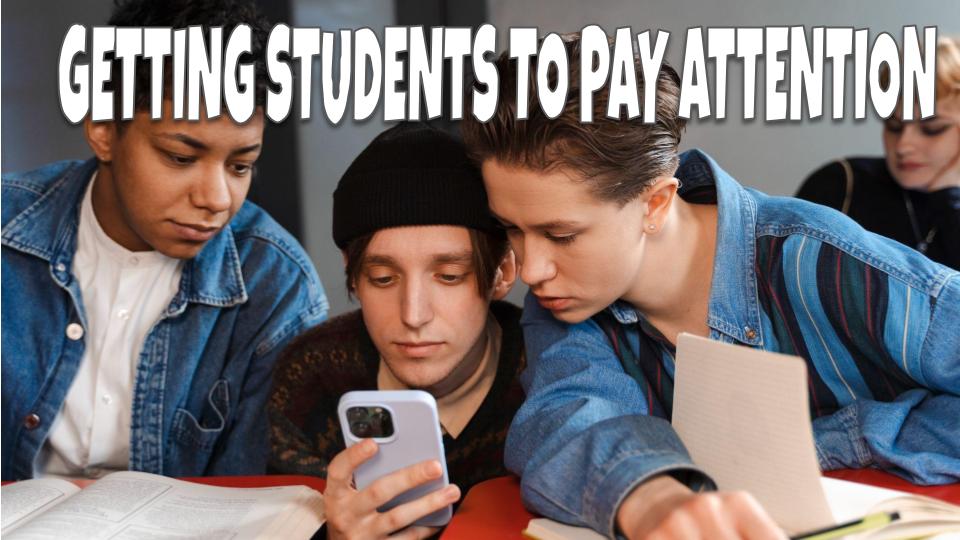
If you’ve been pulling out your hair, trying to get students to pay attention in class, you are not alone. There are many obstacles that are in the way, and I’ve got some classroom-tested solutions that you can try.
There are three big issues that tend to pull students’ attention from the tasks they are supposed to do:
- Their phones
- Distraction due to chatter
- Apathy
I’m going to give you an overview here, as well as links to posts you can go to for more detail. If you want to make a plan for more engagement next school year, settle in and grab some of my classroom-tested strategies.
Getting students off their phones
Cell phones have been a problem since they arrived in the hands of our students. I remember how we scrambled at our school, trying to come up with rules and regulations for their use. Little did we know then how out of control the situation would become. So what can we do? How can we get students off their phones, so we can get them to pay attention?
Many schools are attempting outright bans (which I’m not sure if the best way to go). If your school is not banning these hand-held distractions, here are some things you can try:
👉🏻 Involve your students in the solution
Most of your students know they are on them too much. The reality is that many are actually addicted. Even if the phone is in their locker or backpack, there’s an itch, an overwhelming desire to check it. And this keeps them from focusing on what it is you want them to be doing.
I always found that having honest, open discussions with students really helped. It gave them ownership in the issue and a voice in helping to solve it. And doing so helped to build relationships and climate in the classroom.
So, start your school year with a big old discussion about the problems with cell phones in the classroom. Share your frustrations with it – including your own possible addiction to your phone and how you deal with it as a teacher.
Then, ask the students to help you come up with a strategy for getting everyone off their phones when it’s time to learn. I did this every year and each time, the students were engaged and able to come up with some excellent suggestions – that most followed most of the time.
I’ve written about this strategy before – click here to get more detail
👉🏻 Explicitly teach strategies & model responsible use
Don’t stop with the initial discussion. You’ll need to be constantly reminding students, especially in the beginning of the term. If you do the code of conduct, put it on full display, so you can remind students of what they all agreed to. It’s hard work in the beginning but if you stay on it, and enforce consequences, you will see an improvement.
As always, the best way to teach your students is through modelling. Talk to them about your own phone use and point out how you use it responsibly: “I just want to point out that now that I’ve finished my lesson and you are about to start reading, I’m taking a minute to check my messages. I’m hoping my dentist has called back.” OR “Notice how I keep my phone turned down on my desk, so I’m not distracted by notifications.”
Have a tech break in the middle of every class
One way of getting students to pay attention is to provide a break, particularly one that will allow them to use their phones.
Make it clear to students that you know they want to check their phones but they need to do your work. Tell them that if they meet their part of the bargain, you’ll give the 2- 5 minutes mid class to use their phones. You may see it as lost time, but if you can make this work, you’re going to gain more focus and attention from them. Get more info here.

Get students to pay attention by controlling the chatter
Talk is an essential part of learning. Too much of it causes chaos and too little is also a problem if you’re trying to get your students to discuss something.
It’s important to remember that a silent room does not denote a class that is on task and learning. It can, but those students can be zoned out. Conversely, a room full of chatter can mean students are off task or that they are fully involved in multiple group discussions.
Sometimes we need quiet to concentrate and work, and sometimes we need to talk it out. As a teacher, you’re in charge of facilitating each of these scenarios. But, as with the phone issue, it helps to involve your students in a discussion about how best to handle talk in the classroom. You can find out more about this process here.
And if the issue is that you can’t get some students to speak, you can grab some strategies here.

Dealing with apathy
Oh my. There’s just so much of it these days, right? We can cast blame in various directions, or we can start using some strategies to try to break through.
I fully believe, based on my three decades of experience, that relationships and classroom climate are the foundation of dealing with this. I also know that you’ve heard it before. But if you make it a priority to get to know your students and to create a climate in the classroom where they feel safe and able to learn, you can not go wrong.
You might be thinking: I do all of that and I still can’t get them to work. This is because relationships are NOT enough. Yes, they are the foundation, but there are things that need to laid on top of it – things like active v passive learning, relevant lessons and activities, and a focus on the process, so students know not only what to do, but also feel like they know how to be successful. Read more about this here.
The most important thing in the fight against apathy is that you don’t give up. Keep trying. Students today, unfortunately, need a little bit of training, some metaphorical poking and prodding in order to engage. If they feel like you care about them, that they can trust you to teach them in a safe environment where expectations are set and met, you’ll eventually get them.
Because of all this apathy, there are many students who either do not complete work in class or at home. I have some strategies that you can try on these blog posts:
Getting students to do their work – this post goes into more detail about how focusing on the process – and effective feedback strategies – will engage your students.
If I don’t grade it, they won’t do it – this one gives you more detail on active learning and backward planning.

I sincerely hope that you found some ideas that you can use to get your students to pay attention. Let me know if you have any questions!

This is a great article! I really enjoyed reading your tips on getting students to pay attention.