

Writing literary essays is hard. Students need lots of practice to develop the skills they need to write ones that are cohesive, well developed and organized. But does that mean we English teachers have to be confined to our desks every weekend? I try to avoid that situation, because, you know what? I need a life too. And, after years of trial and error, I’ve come up with some exercises that allow me to teach essay writing skills without grading any papers.
Let me share one of my favourites that you could use with any novel:
We just finished Pride and Prejudice in my IB class, and my students needed more work on writing analytical arguments, rather than plot summaries that danced around a thesis. Instead of writing another essay, we spent two days doing this group activity:

Start with an analytical focus
Each student picked a strip that stated the name of a character and asked a question: how does Austen use this character to critique a convention of her society? Note that the question focuses on how the character is used in the story, and pushes the kids beyond a basic character sketch.
I also gave them an exemplar that I had written, using another character in the book who wasn’t one featured on the strips. We spent a few minutes discussing what made it a good piece of writing, and then they got to work.
Spend time brainstorming
I instructed my students to spend five minutes on their own, brainstorming ideas and details that could answer the question.Any time I do a collaborative activity like this, I make sure students to their own pre-thinking first, so everyone is engaged in the process and one or two people don’t dominate.
After the brainstorming session, students found the other class members with the same strip, and began to discuss the ways that their character is used by Austen to critique a convention of her society.
Give students time to develop assertions & find evidence
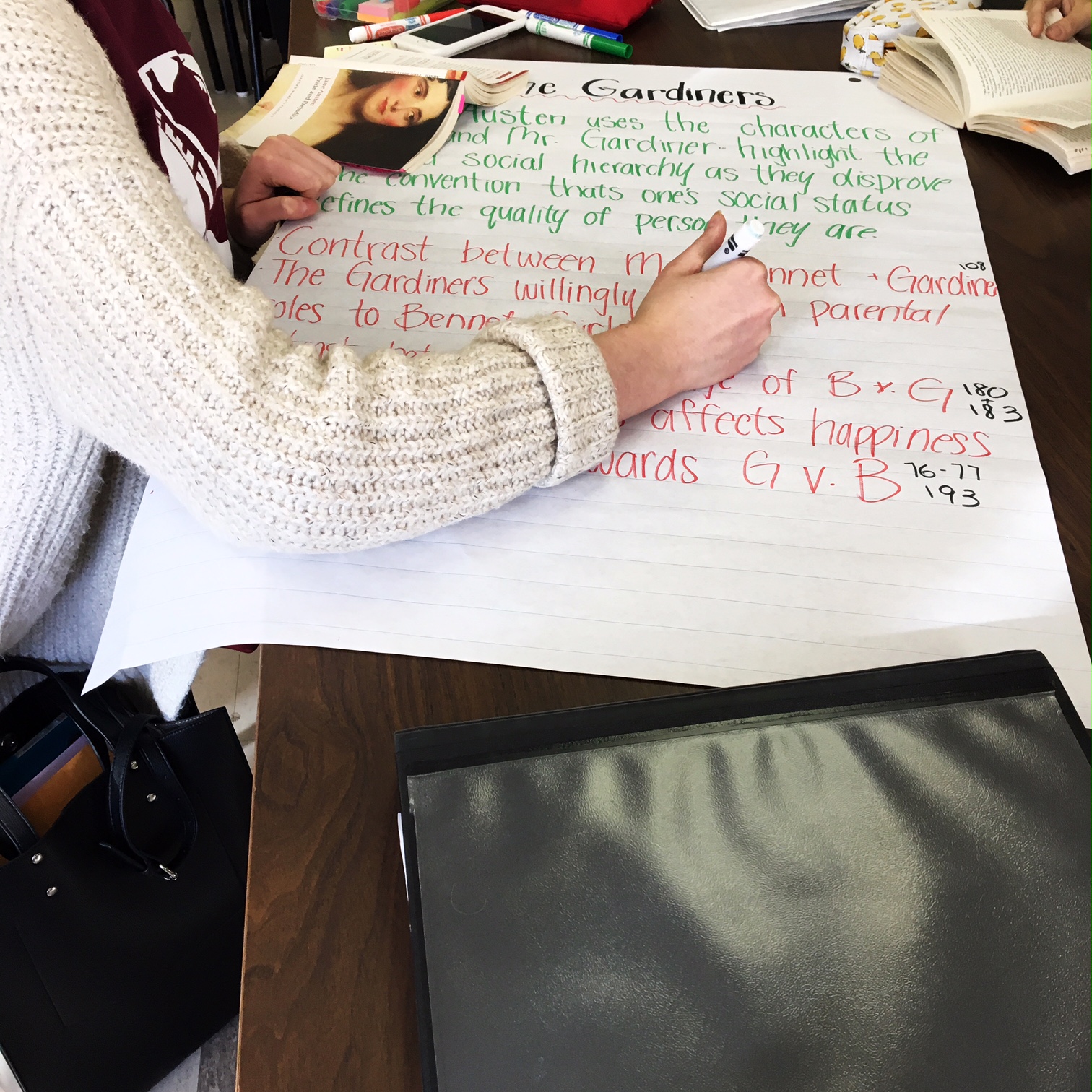
While the students discussed their ideas, I left them alone for the most part to try to work things out on their own. If they were going to far off track, I’d help them get back, but I wanted to save some of the feedback for the full class discussion that followed this process.
This took some time as they had to debate the character’s role in the novel and find textual evidence to support their assertions.
Once they were confident of their argument, I gave them chart paper and markers.
On the paper, they recorded a topic sentence, stating how the character is used in the novel, followed by the details they would use to support it, including quote references.
Class Presentations & Formative Feedback
Once they were finished, each group took turns presenting their argument about the character’s role to the class.
Before they began, I told the class that they were to listen closely so they could give the group effective feedback: did they create a clear topic sentence? Does the evidence they chose support the topic sentence? Was it focused and organized?
Then, after the group presented, we discussed their analysis of the character For the most part, all of the topic sentences were well done, but most groups were just giving us character sketches rather than explaining how Austen was using the character. I kept asking, how do we know that Austen is using this character to critique the convention, rather than just illustrate it? What about Mr Collins shows that she thinks he is foolish?
It was for this reason that I left the kids alone as they worked; I wanted to have these discussions in front of the whole class, so everyone could be part of learning how to improve their ability to analyze. It’s a wonderful way to give formative feedback to the whole class
Tie each part together into a whole

The final step of this process garnered the best discussion. A representative from each group came to the front of the classroom, holding the chart paper. I pointed out that each one was a paragraph in an essay on how Austen uses character to critique the conventions of her time.
Then, I asked them to decide what order we would present the paragraphs. We talked about grouping the characters by the convention and then we had a chat about whether we should be discussing multiple conventions in the essay or just one.
If we chose just one, who would we have to remove? As we spoke, we moved the students around, so the kids had a visual of what this “essay” would look like.
When we were finished, I asked the students if the process had helped. They nodded in unison. They had a chance to collaborate so they could develop their ideas and got to hear lots of descriptive feedback about how to create and organize the argument.
And that’s how I was able to teach essay writing skills without grading any papers.
If you’d like to try this exercise, you can grab some editable character strips HERE. You can also see how I used the same process while teaching students how to write an outline for a persuasive essay on this post.
And, if you’d like some help with lesson planning, I’ll send you five days of freebies that will help you create engaging lessons for your students. Just click HERE.

Love this! Do you link to the character strips?
Thanks for reminding me! I just added a link 🙂
I LOVE this idea! I do DBQ essays in my social studies class and my freshmen have trouble with understanding what the question is asking and how to use analysis to answer it. This exercise would be so helpful when I first teach how to write these essays!
Yes, mine have the same issue. I love these activities for getting them to really dig into it–plus it's more fun for them to work with their classmates on the process.
Nice Post! | Marriot
You are amazing 👏! Thank you!
❤️ You’re so welcome
I absolutely agree with this post. I am going to share this post with my friends and also with my juniors. There are so many of them who don’t know how to write a good essay. We all sit together and practice LSAT Logic Games but we never thought of practicing writing. God! We should have. Thanks for sharing this informative post.
You are so welcome!
The blog was absolutely fantastic! Lot of great information which can be helpful in some or the other way. Keep updating the blog, looking forward for more contents…Great job, keep it up..