

Teaching critical thinking is more important than ever. Our students can now use AI to brainstorm ideas, answer questions, develop an argument, and produce a fairly polished response or essay. They can do this all in a matter of seconds rather than putting in the time or mental effort to do so. While there are certainly times when AI can be a useful tool, there’s a problem when students bypass the thinking process. If we want students to become independent thinkers, we need to make sure they’re still doing the work that builds those skills. So…how do we build critical thinking in the age of AI?
The best way to build those skills is to create a classroom culture where thinking is the norm. That doesn’t require a steady stream of big in-class assignments (although those have their place). Instead, we can give students small, frequent opportunities to think, question, explain, challenge, and develop their own ideas.
The more often they do that thinking themselves, the better they get at it and the more confidence they build in their own ability to do it. That may make them less likely to turn to AI every time they’re asked to come up with an idea or explain what they think.
At the very least, they will be doing lots of thinking in our classrooms.
Teach students what critical thinking looks like
If we want them to become better thinkers, they need lots of opportunities to think and to make that thinking visible, not just when it’s time to write an essay or do a literary analysis. They need to experience what it feels like to work through an idea, question it, defend it, hear another perspective, and sometimes change their minds. They need these opportunities regularly, during the everyday work we do in our classrooms.
Start by helping students recognize that good thinking is a process and, more importantly, show them that the process can actually be rewarding. One of the best ways to do that is through discussion, especially when students are asked to take a position and defend it. Argument, by its very nature, is a social practice and arguing with a pen and paper may not inspire the passion that arguing with another human does.
That’s why I think it makes sense to start with lots of discussion about topics relevant to their lives. We want students to discover that there’s something satisfying about figuring out what you think and being able to defend it, something they simply don’t get when they hand the thinking over to AI.
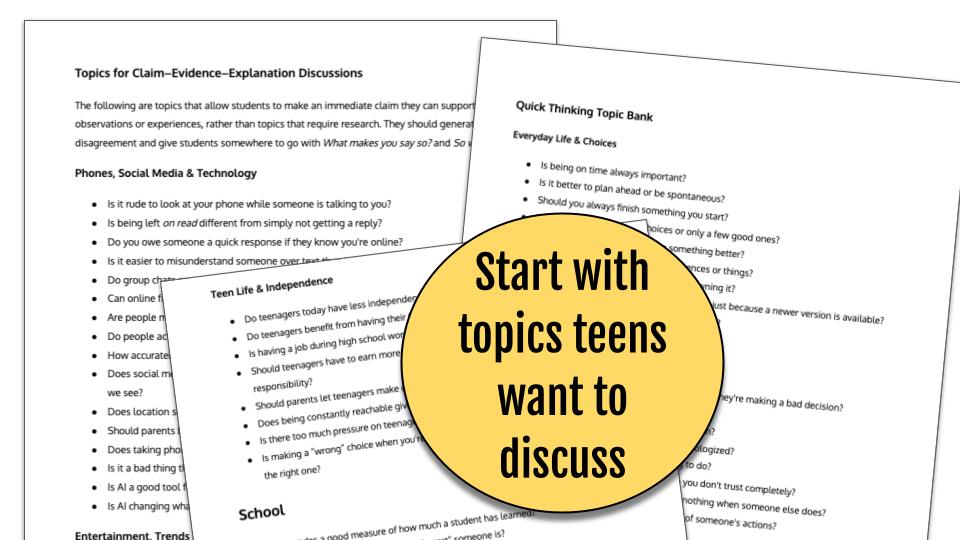
Start with topics they actually care about
If we want students to practise critical thinking, we need to give them something they will engage with. When students already have some knowledge of or interest in a topic, they can focus on developing and explaining their ideas rather than trying to figure out what they’re supposed to say. Then, once those thinking habits are established, we can transfer them to literature, research, and writing.
Diving right into analyzing poetry or interpreting the actions of a character in a text may not get students engaged because they don’t have the interest – or the confidence – to speak up. However, if you use topics they are fired up about, you can start building the critical thinking and discussion skills they will need for your class and their lives.
For example, start with a question students are likely to have an immediate reaction to: Should students be allowed to use their phones during lunch and other breaks at school? Most students will have an answer pretty quickly. It’s also a good starting point because students already have experience with and opinions about it. They don’t need background information or a teacher explanation before they can join the conversation. That means their energy can go into the thinking: Why do I believe this? What reasons support my position?
Ask for more than an “answer”
If we want students to really think through – and support – an idea, we might need to show them how to do this. It’s easy to fall into a pattern of asking a question, getting an ok answer, and then moving on to the next thing. But one answer doesn’t always illustrate a thinking process; sometimes it’s just a guess.
Instead, ask students to explain how they got their answer. Ask them to support what they say with examples, to elaborate when their first response is vague. Ask classmates to build on or refute ideas (after you show them how to refute kindly!). We don’t need to turn every question into a lengthy discussion either. Sometimes one quick follow-up is enough to send the message that an answer on its own isn’t always enough.
Let’s look at how this can work:
A student says, “Yes. We should be allowed to use our phones at lunch.”
You say: What makes you say so?
They reply: “Because it’s our free time.”
You ask: Why does that matter?
They explain: “Because if we’re forced to put them away during class, we should be able to use them when we aren’t in class.”
You continue with: What makes you say so? And so on…
Over time, students will learn that in your classroom, they will be expected to explain their thinking and not just stop at an “answer.” And the goal is to make these follow-up questions so routine that students eventually begin asking them of themselves.
But, you may be thinking, what if you can’t get them to engage in the process?
Give students time to think before they respond
We’ve all asked a question and watched the same few hands go up. While the owners of those hands are ready to answer, some students are still processing the question, some are waiting to see what everyone else says, and some have already decided that if they wait long enough, someone else will do the thinking for them.
To circumvent all that and get more of them thinking, build in opportunities for students to think independently before they respond. It doesn’t have to take long. A little wait time or some brainstorming gives them a moment to gather their thoughts and can make a big difference.
Back to our example: before anyone shares an opinion on the phone question, give everyone a minute to jot down their position and two reasons for it. Now, when the discussion begins, the quickest students haven’t done the thinking for everyone else because every student has done some first
Make room for different answers
Sometimes our classroom questions have a correct answer, and sometimes they shouldn’t. Students need regular opportunities to wrestle with questions where they could come to different conclusions. Those are the questions that require them to make decisions and figure out what they actually think. They also help students move away from one of the habits that can make AI so tempting: looking for the answer rather than developing an independent idea they can support.
And don’t rush the class toward a consensus. With the phones at lunch example, one student might argue that lunch is free time. Another might point out that phones can keep people from actually talking to each other. Someone else might suggest that the problem isn’t phones themselves but how they’re being used. Each of these is valid and worth discussing. More importantly, they provide an opportunity for students to consider multiple viewpoints.
Make it okay to struggle with an idea
Students are often uncomfortable when they don’t know an answer right away, and that’s understandable because school has trained them to want to be right. AI makes it even easier to avoid that discomfort: Why wrestle with an idea when you can type a prompt and get an answer immediately?
But we know that struggle is where the thinking happens. To help them be ok in that process, we can give students opportunities to sit with a question, try an idea, realize it doesn’t quite work, and try again. We can show them that not knowing immediately isn’t a problem we always need to fix.
So, during your cellphone discussion, throw in a complication: What if someone spends every lunch alone scrolling on their phone? What if they want to be alone? What if phone use at lunch creates drama and conflicts that spill into afternoon classes? A position that may have seemed straightforward gets complicated and by introducing these ideas, students might say, “I hadn’t thought about that,” or “I think I need to change my answer.” Hopefully they will learn that it’s ok to reconsider when new info is presented (and listened to).
Let students do more of the talking
We should model thinking for our students, but eventually they need to do it themselves. Look for ways to shift some of the questioning and responding away from you and toward them. This doesn’t mean turning the class over to an unstructured discussion and hoping for the best. Students will often need guidance and support as they learn how to have productive conversations. And if we’re always the ones guiding the discussion, we’re still doing a lot of the thinking for them.
Small group discussions are perfect for this, especially if they are preceded by modelling, and students get some scaffolds like sentence stems to get them started. Sentence stems, or frames, are a wonderful tool for those who don’t have the confidence to do it on their own; once they get it, you can take them away.
When students understand the process, you can stop being the person who always asks the follow-up questions. When someone argues that phones should be allowed because lunch is free time, another student might jump in and ask, “What would you say to someone who thinks phones make lunch less social?”
And you can sit back and enjoy.
Value the process, not just the finished product
This may be one of the biggest shifts we need to make in the age of AI. When too much emphasis is placed on the finished product, like the paragraph, essay, presentation, or project, the temptation is real, and the access is easy. Besides, a polished final product doesn’t necessarily tell us much about the thinking that went into creating it anymore, does it? So we need to pay more attention to the process (which was always a good idea, long before AI…)
Devoting time in class to the process, showing students how to develop and communicate an idea, will give them the confidence they need to do their own work. And when a lot of that thinking happens in class, without technology doing the work for them, we can actually see students developing those skills for themselves. When we emphasize the thinking process and not just a finished assignment, we are showing students that the process IS important, that it’s the journey not the destination that matters (Sorry for the cliché, but when it works, it works!)
Make critical thinking a daily habit
We don’t need to completely redesign our courses or add elaborate critical thinking activities to make this happen. The phone discussion, for example, doesn’t need to take a whole period. Ten minutes may be enough. The next day, you can give them a different question and repeat the process: think first, take a position, explain why, listen, challenge, reconsider. Do it often enough and students begin to understand that this is what we do in this class.
Students will learn that we aren’t always looking for the quickest answer because we are far more interested in how they got there. They will learn that their own ideas have merit. And hopefully, more of them will learn essential critical thinking skills that they will use their whole lives.
Our students have access to tools that can give them answers almost instantly, and so what they need most from us are opportunities to develop the skills that will help them decide whether those answers are any good and the confidence to know that they are capable of doing the thinking themselves.
If you like this approach and want some help implementing it, I’ve got you covered!
Critical Thinking Activities in the Age of AI
Writing Prompts that build the habit of revision
I hope you got some usable strategies to build critical thinking in the age of AI. Let me know if you have any questions!
Leave a Reply