

If your students’ eyes glaze over halfway through a lesson, it may be time for a quick brain break. Brain breaks for middle and high school students help reset attention, restore energy, and get students ready to learn again. The best ones take only a few minutes and still reinforce ELA skills. These quick activities aren’t wasted minutes, nor are they a sign that you are a slack teacher. What they are is an investment in focus, energy, and learning. When we intentionally give students a moment to reset, we help them return to reading, writing, and discussion with renewed attention and interest. That’s why I’d like to show you how to use brain breaks for middle and high school ELA.
The good news? You can also easily make these short breaks ELA-focused without losing the fun and spontaneity that these activities provide. In short, you can increase attention and engagement AND build skills at the same time. However, the best news of all is that you can make all this happen in less than five minutes. Let’s find out how they work!
What are brain breaks?
A brain break is a short activity that gives students a mental reset so they can return to learning with better focus.
How long should brain breaks be?
Most effective brain breaks take 2–5 minutes.
How do Brain Breaks Improve Student Focus?
They work because they:
-
Combat attention fatigue
-
Give students a cognitive reset
-
Build in movement to improve retention
-
Use social interaction to boost engagement
Do brain breaks work for high school students?
Yes. Older students benefit just as much as younger ones. Quick discussion prompts, word games, and movement activities help high school students reset their attention.
Why Brain Breaks Work in an ELA class:
Research shows that students can only maintain deep focus for so long before their brains need a break. When attention starts to fade, retention drops, and distracted and distracting behaviors occur. A quick break of three to five minutes allows students to do a reset, which boosts memory, motivation, and creativity.
In an ELA classroom, that matters. Reading comprehension, critical thinking, and writing all require sustained mental effort. A short, playful interruption gives students a chance to recharge, so they can engage more deeply when they return to the task.
Even the best lessons can lose momentum—but sometimes all it takes is a short, engaging activity to get students back on track. Mini activities or challenges can reenergize and refocus students while still building essential ELA skills. They can be used to:
✅ Provide a fun, energizing “break” after a content-heavy lesson or period of work
✅ Refocus attention after transitions
✅ Wake students up whenever you think you’re losing them
✅ Review skills you’ve already done
✅ Warm-up at the beginning of a class
✅ Fill in the last few minutes of a class that has finished early
✅ Instill some fun that focuses on learning
✅ Show students that learning CAN be fun
The Best Brain Breaks for middle and high school ELA Classrooms
You may be thinking that fun energizers and brain breaks are taking the focus from the work you should be doing.
First of all, it IS ok to take a total break from class work, but you can also provide a break and a boost for students with quick activities that focus on skill-building.
Energizing breaks don’t have to take you off-task, either. With a few creative tweaks, you can design activities that keep students moving and thinking about language, literature, and storytelling. You can even use them to push students to fully support their ideas and to train their brains to think about ways to prove their arguments.
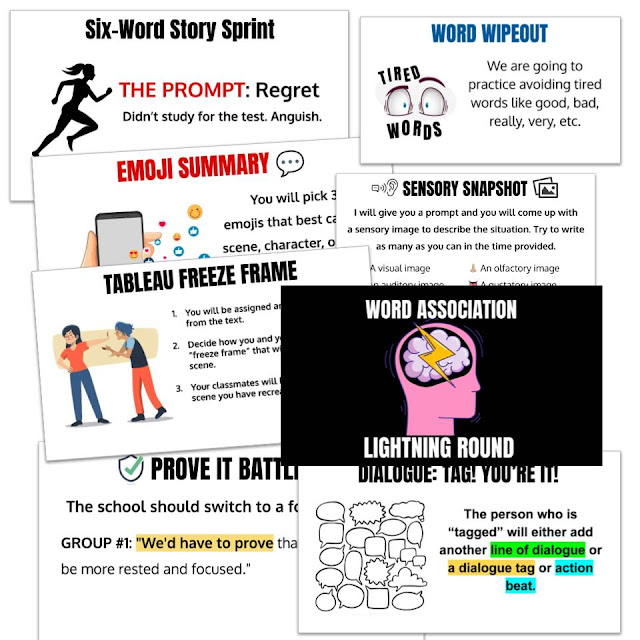
How to use brain break activities for middle & high School ELA
-
Use them intentionally: Plan short breaks every 15–20 minutes during high-focus tasks, like essay writing or text analysis. They are also quite effective during classes that are very teacher-centered, like when you are providing notes or direct instruction that takes long chunks of time.
-
Keep them short: 3–5 minutes is plenty of time to reset the brain.
-
Connect to learning goals.: A quick word challenge or creative writing prompt keeps the flow of your ELA lesson intact.
-
Make it predictable: When brain breaks become a routine, students learn to re-engage more efficiently. The first few times you do one will take longer, as students will need to learn the routine. However, once they know how the brain breaks work, you can quickly and easily work them into your classes.
Use brain breaks when:
• You notice that your students are losing focus
• Transitions take too long
• Discussion energy drops
• Energy for a task is lagging
The takeaway for how to use brainbreak activities for middle & high School ELA:
Brain breaks don’t just give students time to rest — they help them learn better. A short, purposeful pause can reignite curiosity, refresh focus, and strengthen essential ELA skills. Whether it’s a word sprint, imagery challenge, or quick grammar game, your students will return sharper, calmer, and ready to dive back into deeper learning. So, I’d urge you to try some fun ELA Energizers and brain breaks with your students. It could be a game-changer.
Planning quick brain breaks can take time, especially when you want them to still reinforce reading, writing, and discussion skills. That’s why I created a set of ready-to-use brain break activities designed specifically for middle and high school ELA classrooms: . Click here to grab fourteen ready-to-use brain breaks that you can use with your students. And, if you want to learn about more ways you can use games and challenges to engage your students, read this.
More ways to energize and engage:
Leave a Reply